
Three Friends, One Login: Running Several Mining Accounts From a Phone
Sooner or later a careful hobbyist becomes the person other people ask to look after their machines. That turns a single worker into a small portfolio: a 362 TH/s rig in a garage, a 1.448 PH/s rack in a rented room, a 3.62 PH/s operation in a warehouse. Three accounts, three owners, one set of notifications, and a very real risk of quoting one owner's coins to another.
Key takeaways
- Each account needs its own payout address; a shared address turns a bookkeeping problem into a dispute.
- 362 TH/s credits 0.0001624 BTC a day, or $13.20 net after the listed 4% on the block-reward share.
- Label every worker with the owner's initials before adding a second account, not after the first mistake.
- Reconcile monthly, in BTC, and convert to dollars only at the end.
How a favor turns into a portfolio
It starts with a neighbor who cannot get his miner onto the network. Then a cousin asks whether the machine on the shelf is worth plugging in. By the third request you are running other people's hardware from your own phone, and the informality that made the arrangement pleasant becomes the thing most likely to break it. Nobody has agreed what "your share" means, and the numbers are all sitting in one list.
Fixing it is mostly clerical. Every owner gets their own account and their own payout address, even when the machines sit in the same room and share a switch. Separate accounts mean separate statements, and a statement is the only artifact that settles an argument about who earned what. The pool does not care how many logins you hold; it cares that shares are attributed to a worker.
The phone is where the separation either holds or collapses. A single notification stream with three unlabeled workers is worse than no notifications at all, because it teaches you to ignore the one that matters. Label first, then invite.
Naming scheme that saves an argument later
Use a prefix that identifies the owner and a suffix that identifies the machine. Something like RK-garage-01 costs eight characters and answers the only question anyone asks in a dispute: whose unit produced this share. Reserve the account name for the person, the worker name for the box, and never let the two drift.
Write the mapping on paper as well. A note in a drawer sounds primitive until a phone is lost and the login has to be rebuilt from memory at an awkward moment. The note should carry the account, the worker prefix, the payout address and the owner's contact. Four lines per person is enough.
Then decide who receives which alert. The person responsible for the machine should get the hashrate and temperature warnings; the owner should get the weekly summary and anything involving money. Splitting the two streams keeps the owner informed without waking them because a fan spun down at 3 a.m.
Reading three accounts on a small screen
Account switching is the feature that makes this workable. One login, several accounts, and a list that shows each one's hashrate on a single page. The trick is to read the list in a fixed order every day: smallest account first, largest last. That order becomes a routine, and routines catch anomalies that a random glance misses.
Compare each worker against its own history rather than against its neighbors. A 362 TH/s unit that has always run at 355 to 368 is healthy at 360. A 1.448 PH/s rack that has never exceeded 1.4 PH/s is not unhealthy merely because the warehouse next door runs faster. The app shows absolute numbers; the judgment has to come from your own baseline.
For the money side, read BTC first and dollars second. Coins are what the pool actually owes; dollars are a conversion at whatever price the day happens to offer. Reporting a total in dollars makes two owners' results move together even when their output did not, which is exactly the confusion a monthly close is meant to remove.
The monthly close, account by account
Pick one date, once a month, and export the credit history for every account. Thirty days is long enough for the numbers to be meaningful and short enough that a mistake can still be traced to a specific week. Convert at a single published rate rather than at the rate on the day you happen to do the arithmetic.
Send each owner three figures: BTC credited, days with zero credit, and the average hashrate reported. Nothing else is needed. If the days with zero credit are more than the days the machine was intentionally off, there is a story to investigate before the next invoice.
| Account | Hashrate | BTC per day | BTC per 30 days | USD net per day |
|---|---|---|---|---|
| RK-garage | 362 TH/s | 0.0001624 | 0.004872 | $13.20 |
| LM-rack | 1.448 PH/s | 0.00064965 | 0.0194895 | $52.81 |
| TS-hall | 3.62 PH/s | 0.00162413 | 0.0487239 | $132.03 |
| Combined | 5.43 PH/s | 0.00243618 | 0.0730854 | $198.04 |
The combined row is for your own sanity check, not for sending. Owners should see their own line, because a combined figure invites the question of why one unit appears to earn more per terahash than another when the difference is rounding at three different sizes.
The Profit Calculator is the check on that arithmetic: if the three accounts together should produce more than the export shows, a worker is missing from the list.
Worked example
The three accounts in the table come from the same per-terahash rate, so the arithmetic is one multiplication repeated at three scales.
- The network pays 450 BTC a day across 1,003,000,000 TH/s, so one terahash is 450 ÷ 1,003,000,000 = 0.00000044865 BTC.
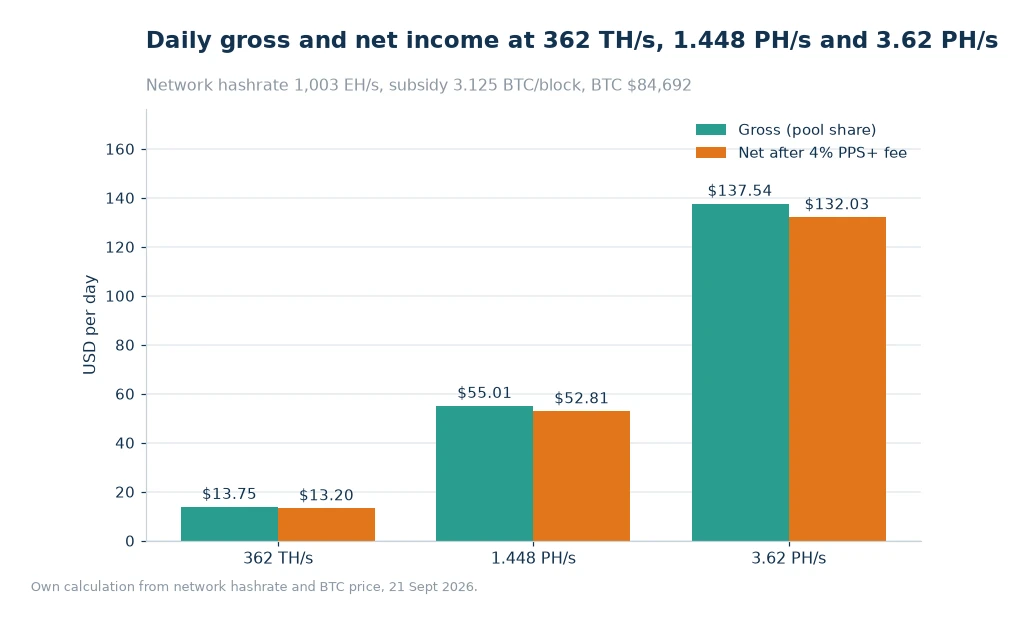
- Garage unit: 362 × 0.00000044865 = 0.0001624 BTC, which is $13.75 gross at $84,692.
- Deduct the 4% listed against the block reward: 13.75 × 0.96 = $13.20.
- Rack: 1,448 TH/s × 0.00000044865 = 0.00064965 BTC, or $55.01 gross and $52.81 net.
- Hall: 3,620 TH/s × 0.00000044865 = 0.00162413 BTC, or $137.54 gross and $132.03 net.
- Thirty-day garage total: 30 × 0.0001624 = 0.004872 BTC.
- Difference between gross and net on the garage unit: $13.75 − $13.20 = $0.55 a day, or $16.50 across a month.
When someone wants their hardware back
An owner leaving is the normal end of these arrangements, and it should be as boring as the start. Change the worker name to something like RK-returned, note the final credit date, and send the last statement. Do not delete the account on the same day: a PPLNS balance can settle after the hardware has moved, and the address still needs to exist to receive it.
Delete the login only when the balance is zero and the final payment has confirmed. Until then the account is the receipt. The multi-currency wallet keeps the destination address inside the same account, which makes this handover a matter of checking one line rather than hunting for a screenshot.
If the departing owner wants to keep monitoring, the ViaBTC App Download gives them their own installation on their own phone, signed into their own account only. That is cleaner than leaving a shared login alive, and it removes you from the middle of every future question.
Frequently asked questions
Can one phone watch several mining accounts?
Yes. The app supports multi-account management, so a single installation can hold several accounts and switch between them, with worker names and alerts kept separate for each.
Should friends' rigs share my payout address?
No. Separate accounts and separate addresses keep each statement attributable; a shared address makes every later reconciliation a negotiation rather than a lookup.
How often should the accounts be reconciled?
Once a month is enough, using a single conversion rate, because thirty days of hourly credits smooth out daily noise while still leaving a traceable record.
Keep the ledger simpler than the hardware
The technical side of this arrangement is trivial. The social side is not, and it is the part that fails. Separate accounts, fixed worker prefixes, one monthly statement per owner and a paper note in a drawer will carry the arrangement through a lost phone and an argument about a single missing day.
Start with the smallest account. Get the labeling and the monthly close right on one 362 TH/s unit, then add the next owner. Three accounts handled well feels like one; three accounts handled casually feel like thirty.
Sources: ViaBTC app, wallet and statistics pages for account features and settlement detail[1]. Published 24 Oct 2026 from 21 Sept 2026 readings: $84,692 per BTC, 1,003 EH/s, 132.76 T difficulty, 144 blocks a day at 3.125 BTC. Monthly totals assume continuous hashing for 30 days.